
Periglacial geomorphology deals with the form, and processes that affect the form, of the surface geology in the cold, wet glacial environment. A prominent spokesperson in that field, Prof. Kevin Hall, wrote this in 2006[1], aimed at those of us in building science among others:
Sad to say but, despite our accessibility to literature, there is little cross-fertilization between disciplines: engineers continue with their standard techniques (whether or not those have any relationship whatsoever to actual processes), geomorphologists work in the landscape but frequently without recourse to non-landscape studies, building conservation and asphalt road studies stay within their topic-specific literature, and specialists such as rock fracture mechanics scientists stay within their, often theoretical, sphere. Reading of the literature within any discipline is often as if none of the others even exist; sometimes with amazing conceptual outcomes or decisions. …. Here, from my own perspective, I hope to suggest some issues to consider within the context of freeze-thaw affecting building stone.
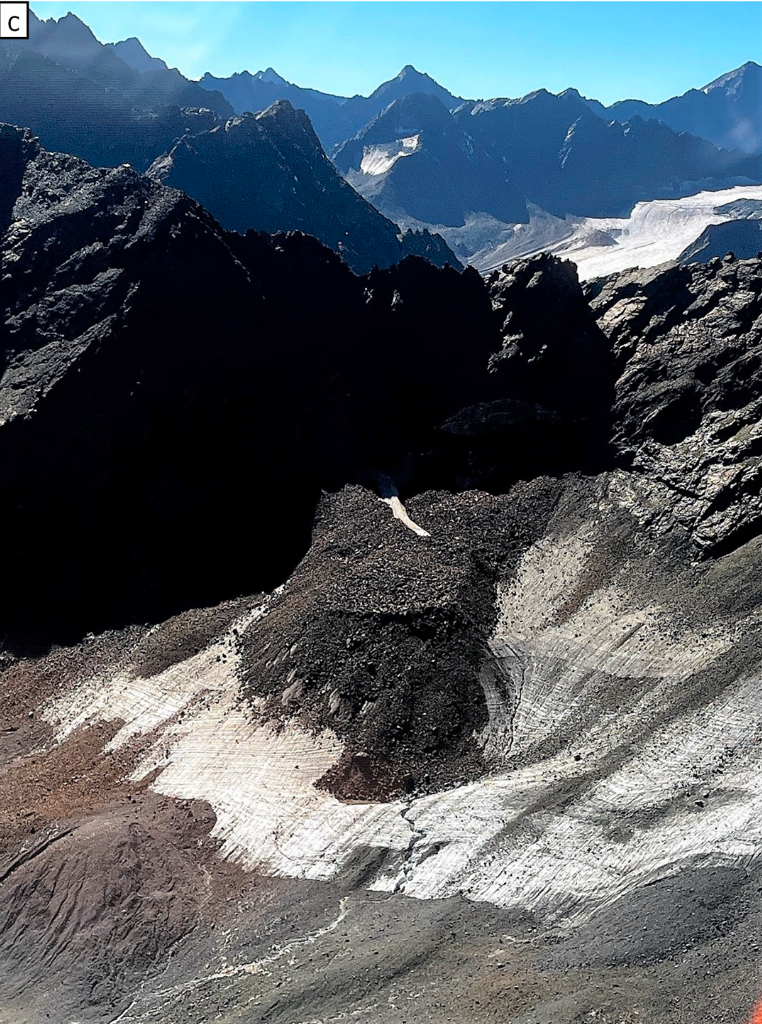
It’s a daunting task to step into an alien field, an alien silo. But it holds nice surprises. They produce technical advancement papers (tough going sometimes) and survey papers which are a delight to read. I don’t often get into alpine or arctic glacial environments, and this work takes you there. The image below is from Fleischer et al (2023)[2].They deal in depth with freeze-thaw damage to rocks, as we do. The nicest surprise was to find that their historical roots, while different from ours, have something very special in common with us.
Freeze-thaw
Does freeze-thaw damage occur in historic masonry buildings? For now, I suspect it does not, except where masonry faces the sky. Sky-facing masonry is subject to direct wetting, gravity water loading, clear-sky chilling, melting, and is able to sequence these events in a way that batters stone and brick. Ice fronts may grow toward one another—a recipe for fracture where water has no place to go. Vertical masonry faces are treated much more kindly by nature. The water loading is less, the likelihood of saturation is less, the sky exposure is less and warmer at the horizon, and it’s hard to imagine having more than one cooling front. Poor periglacial geomorphologists—their stones are oriented any which way.
According to Colin Thorn[3], the field got its start with a paper by Lozinski (1909), using the term periglacial facie. Lozinski kicks off the whole enterprise of periglacial geomorphology with this: “The peculiarity of periglacial facie consists in the splitting of rocks in situ, and freezing is the most important factor of the periglacial climate.” Thorn writes that this effort “to identify the chemistry, physics and/or mechanics of periglacial processes”, which we presume would include freeze-thaw damage to stone, to be only one of five objectives for the current field, alongside others such as the study of permafrost. Still, freeze-thaw damage to rocks looks central to the field. We can imagine the earliest researchers, knowing full well of the volume increase as water turns to ice, wished to investigate its effect by surveying the landscape as well as documenting the theory—the chemistry, physics and mechanics of fracture. Inductively and deductively.
The first widely-accepted laboratory result where ice deformation was created was by Stephen Taber in the 1920s, discussed here. He showed that with 1) a base layer of saturated soil such as clay kept warmer than freezing, and 2) larger granule sand or gravel above the clay at or below freezing temperature, an ice layer will form and grow at the interface. It’s not too hard to maintain those temperatures at the interface, since small pores (clay) cause a depression in ice-forming temperatures. This is ice lensing or frost heaving. Taber did not claim this effect was capable of fracturing stones though it certainly could lift a load.
In 1936, Oliver Grawe[4] put the field on notice. He claimed: Rock disintegration by ice is nil. He begins by listing what ice does do as presented “so tritely in geologic textbooks”:
…effects produced by the freezing process, such as (i) heaving of soil; (2) ascent of boulders through soil; (3) disruption and disintegration of rock; (4)formation of steep cliffs and serrate divides; (5) formation of scree, talus, and soil; (6) induration or cementation of soil by the ice, temporarily rendering the soil less pervious and less subject to transportation by wind and by water; (7) preparation of material for further weathering and for transportation.
He traces previous studies that discuss pressures within stone that could theoretically occur. These pressures prove to be high in an imaginary captured water bubble within stone, acting against the tensile strength of the rock. Grawe cites four conditions which must be met for these pressures to apply:
The development of this theoretical maximum pressure is dependent upon the simultaneous fulfilment of four necessary conditions: (I) the water must be confined completely so that it cannot migrate from one part of the rock to another as the pressure increases; (2) the system must consist of only one component, water, which initially is present only in the liquid phase; (3) the temperature must be -22° C.; (4) the rock confining the water must be strong enough to withstand the pressure. The probability that all these conditions will be fulfilled during natural freezing of water in rock is not very great.
This leads him to the heart of his paper.
As in soil, water may freeze in consolidated rock as it would in an open system. In this case rock disintegration is nil, for the only force is that exerted to push back the unfrozen water and to express the included air.
The term “open system” is critical. Normally, in one-directional chilling, if the water found a way in to saturate the stone, it can find its way out again. As an ice front moves through saturated stone, the water may compress the air found in the stone, or it may simply push water ahead of itself. In a closed system, these exit paths are closed off, likely by a second cooling front. It compares closely to the bursting of water pipes due to freezing.
Pressure in a fluid tends to be rather uniform. Three common exceptions—gravity (pressure as a function of water depth), velocity (Bernoulli’s finding), and viscosity (applied pressure takes time to pass through). Proposing that a static, connected matrix of fluid can be at atmospheric pressure at point A and at stone-fracturing pressure at point B would require some serious explaining.
How did Grawe’s discussion go over among his colleagues?
Prof. Thorn, who was mentioned above, and with whom I had communication, describes the growth in the theory of freeze-thaw affecting stone:
From its inception, periglacial geomorphology has been dominated by the concept of frost wedging, a synonym for weathering by freezing and thawing. The story is one of casual empiricism gathering respectability by repetition until it attained the stature of an article of faith. Despite lacking detailed theory, the concept gained some scientific credence in the 1950s and subsequently by extensive laboratory testing of small rock samples under conditions that may or may not mimic natural ones.
There were early warnings by Grawe (1936) of the limitations and requirements which might constrain frost weathering of bedrock, but Walder and Hallet’s paper (1985) provided the first convincing theoretical treatment.
The paper by Walder and Hallet[5] (1985) is rough going for an amateur like myself, especially compared to the almost breezy discussion by Grawe. Their analysis begins with Taber, who was able to show, under specific conditions, that ice was indeed able to displace materials of some weight, and to do this in an open system. For Taber, the weight of the overburden is carried by the underlying porous solid, not by the fluid.
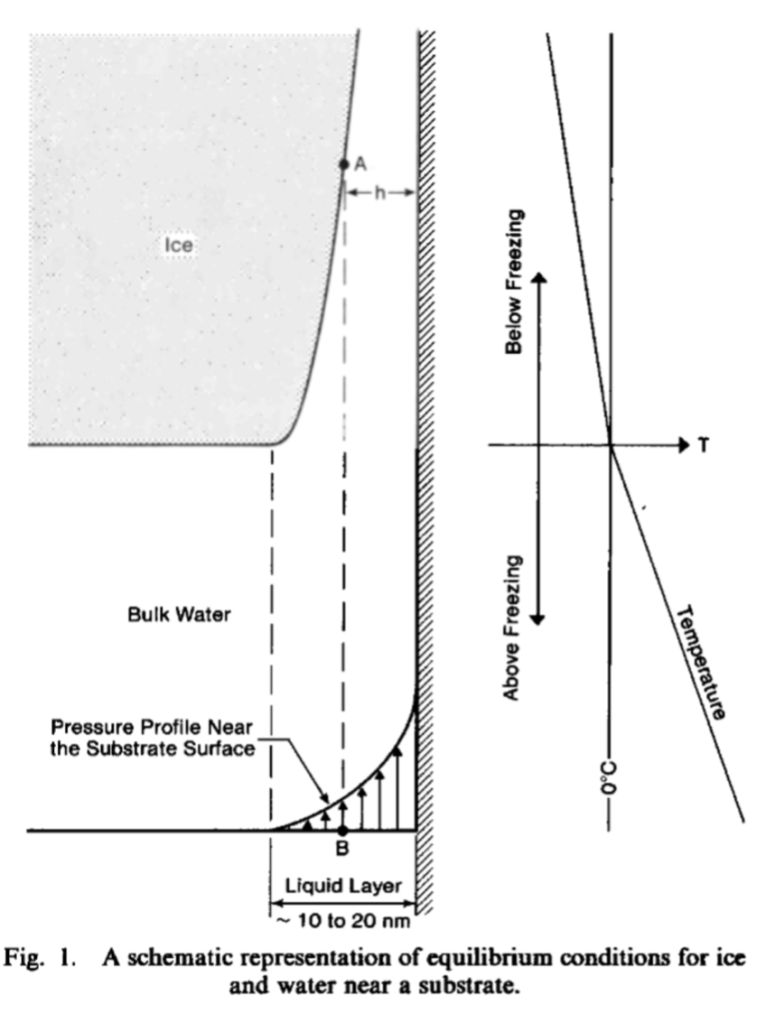
They claim that even in open systems, with the fluid at generally atmospheric pressure, local fluid pressures may develop sufficient to crack stone as ice crystals grow toward stone substrate. They invoke, but do not use, “disjoining pressure”, a concept developed by Derjaguin[6]. I feel critical of this concept, but it’ll take another later post to try to tackle the concept[7]. This idea of local high pressure is also found in a paper by Gilpin (1980)[8], whose previous discussion of dendritic ice was very helpful in our work on frozen water pipes. This paper leaves me uneasy. See the figure below. The claim here is that the hydrophilic nature of the substrate, together with an encroaching ice mass, causes fluid pressures to increase with proximity to the substrate. I can’t imagine a manometer (a nano-manometer) that could measure this effect.
These researchers claim that as ice grows to within a few nanometers of the substrate, non-everyday pressures are achieved in the tiny gap. I have two big problems with that. 1) The substrate surfaces are shown as Euclidian smooth lines while at the nanometer scale everything is rough (three water molecules, for example, measure 1 nm across). Roughness alone would put solid surfaces into contact. 2) Ice nucleates at the substrate and grows inward toward the water, not the reverse. The ice-substrate interface is solid-solid, which cannot and does not apply pressure.
The last paper in this review is by Kevin Hall (2006)[9] of the University of Northern British Columbia.
Does freeze-thaw damage occur in North American masonry? The answer begins with identifying the damage in the field. Hall begins his chapter with these two points—the plurality of freeze phenomena, and insufficiency of evidence:
With respect to freeze-thaw weathering of building stone, the ‘freeze-thaw’ attribute is usually discussed as if it were a singularity. That is to say, the term is used in a manner that suggests the weathering (‘freeze-thaw’) comprises but a single mechanism as indicated by the descriptor used. Further, in many studies the action of ‘freeze-thaw’ appears to be assumed rather than proven – the considered role being based on a climate that experiences “cold” coupled with observed physical weathering of the stone. Equally, in many studies where the building material resides in a zone of cold winter conditions so the monitoring protocols, assuming the activity of freeze-thaw, are set up in such a manner as to monitor just this and, in so doing, are inadequate for determination of other processes. Thus, the “proof” of freeze-thaw becomes one of a self-fulfilling prophecy rather than scientific evaluation.
This is a critical observation. It is not sufficient to observe damage—weathering–in a cold climate in order to conclude freeze-thaw as the culprit. Hall lists contributors to the theory of stone fracture under cold conditions:
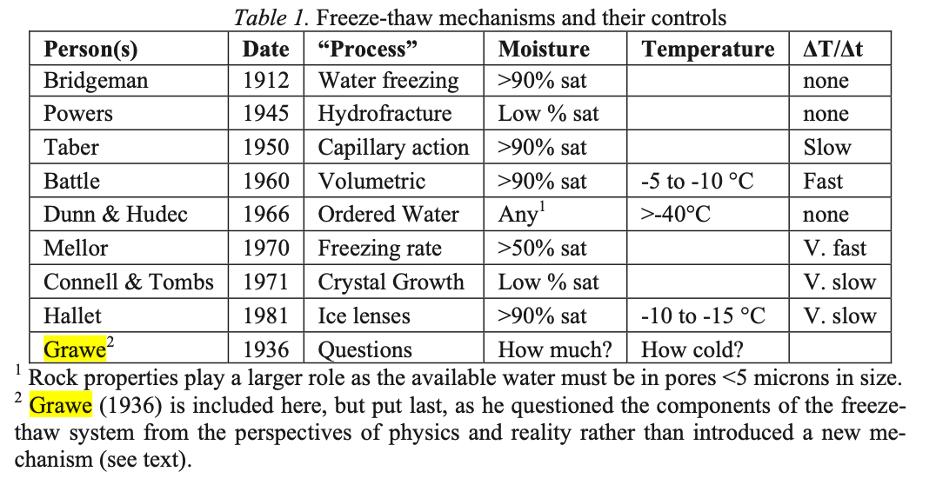
Hall continued:
The paper by Grawe (1936) is cited within Table 1 insofar as it questioned the many held beliefs with regard to freeze-thaw weathering, notably the possible stresses that can be exerted by freezing water, and despite being published over 80 years ago the questions raised are no less valid today. Indeed, the veracity of freeze-thaw might be less strong had greater recognition been given to this paper in many studies. Grawe (1936) raised the questions surrounding the greater-than-any-rock-can-withstand pressures that freezing water can generate, and thus, in principle, the overall possible effectiveness of the process.
We might compare it to jurisprudence. We may use the terms means, motive and opportunity. (Ignore motive, rocks don’t hold grudges.) Opportunity is the weak factor—cold, wet and damaged stones present sufficient evidence if the culprit is presumed guilty. A presumption of innocence requires a presentation of means. Grawe claimed the means are absent in an open system. Thorn is satisfied that Walder and Hallet provide this mechanism. Jury is still out, my jury, that is. I am convinced, however, that in order for building science to adequately address freeze-thaw effects in building stone, the contributions presented here represent a gold mine of orderly thoughtful analysis.
Origin of building science
Thorn shows us that what gave rise to his field is phase change from water to ice, with its volume increase. They didn’t know what the effect would be, but saw the periglacial environment as a natural laboratory. There is something intriguing about phase change, and at the outset they had wonder instead of answers, and a clear agenda to work out.
Building science began with “condensation”. I hadn’t realized that until preparing this piece. Phase change. Intrigue. Natural laboratory. Agenda… Wonder.
[1] Hall, Kevin. 2006. “Monitoring of thermal conditions in building stone with particular reference to freeze-thaw events” In Fracture and Failure of Natural Building Stones: Applications in the Restoration of Ancient Monuments, edited by STAVROS K. KOURKOULIS. Springer Netherlands. https://doi.org/10.1007/978-1-4020-5077-0_24.
[2] Fleischer, Fabian, Florian Haas, Moritz Altmann, Jakob Rom, Camillo Ressl, and Michael Becht. 2023. “Glaciogenic Periglacial Landform in the Making—Geomorphological Evolution of a Rockfall on a Small Glacier in the Horlachtal, Stubai Alps, Austria.” Remote Sensing 15 (6): 1472. https://doi.org/10.3390/rs15061472.
[3] Thorn, C. E. 1992. “Periglacial Geomorphology: What, Where, When?” In Periglacial Geomorphology. Routledge.
[4] Grawe, Oliver R. 1936. “Ice as an Agent of Rock Weathering: A Discussion.” The Journal of Geology 44 (2, Part 1): 173–82. https://doi.org/10.1086/624415.
[5] Walder, Joseph, and Bernard Hallet. 1985. “A Theoretical Model of the Fracture of Rock during Freezing.” Geological Society of America Bulletin 96 (3): 336. https://doi.org/10.1130/0016-7606(1985)96<336:ATMOTF>2.0.CO;2.
[6] Derjaguin, B. V., N. V. Churaev, and V. M. Muller. 1987. “Disjoining Pressure.” In Surface Forces, edited by B. V. Derjaguin, N. V. Churaev, and V. M. Muller. Springer US. https://doi.org/10.1007/978-1-4757-6639-4_2.
[7] Here’s my objection: At the kilogram scale, we can knock a stone and an ice crystal together, and they do not repel. At the gram scale, same thing. At the milligram scale, same thing. It takes imagination at the microgram scale, but I cannot intuitively sense any repulsion. Disjoining pressure operates at the nano-scale where surface roughness matters greatly. Is there any sensible embodiment of disjoining pressure? I haven’t encountered any.
[8] Gilpin, R. R. 1980. “A Model for the Prediction of Ice Lensing and Frost Heave in Soils.” Water Resources Research 16 (5): 918–30. https://doi.org/10.1029/WR016i005p00918.
[9] Kevin Hall, 2006. op cit.


Leave a comment